
Always Audiences, Never Artists
Updated: Jun 29
Composite Motion 1: Access to Work – Always Audiences, Never Artists
A Trade Union tradition is to composite similar motions into one motion. Compositing effectively means that two or more motions and amendments are merged into one motion.
The composite motion was quite a long motion which is produced at the end of this article, however, it opens with the following two paragraphs:
‘Conference condemns the deterioration of Access to Work (AtW) through excessive delays, arbitrary caps, and restrictions on support workers, particularly BSL interpreters.
These changes disproportionately impact self-employed, freelance, and gig-economy workers across multiple sectors. Unless Disabled workers are backed by a supportive employer, cuts to AtW result in a myriad of negative outcomes.’

The motion was moved by Daneka Etchells and this is what she said:
Conference, Daneka Etchells, Deaf Disabled Members Committee for Equity. First time at TUC Conference and first time speaking
Gig economy workers, workers without salaried positions, are disproportionately affected by Access to Work. Figures obtained by Disability News Service, and Disability Arts Online, have both found that from the 16th April 2026 the current waiting time for self-employed Access to Work applications is 20 months (or 86 weeks) compared to 8 months (or 38 weeks) for employed disabled people. Both waiting times are abhorrent. But one is longer than the other.
Being employed as opposed to self-employed, means that there is often a reserve fund that can be accessed, or the infrastructure for an access compromise that can be implemented during these waiting times. And whilst this means that many disabled employees work through less-than-ideal, inaccessible harmful conditions in the meantime, there is often something that can be temporarily enacted. There is also promise. We do note that due to workplace prejudice or resource, this isn’t always the case.
However, when you are self-employed, the rule is go without or pay up yourself. This results in a vast inequity. Those who can personally foot the bill continue to work as artists, and due to large overheads this can be arduous even for the most affluent, but those from low socio-economic backgrounds are forced to leave.
As a working class disabled artist, I’ve felt this personally. Blocked career progression, loss of income, silencing of voice.
These waiting times mean loss of work. The often last minute having-to-say-no does irreparable damage to our reputations, in industries where reputation is the most stable and hungered currency. It paints us as unreliable, lazy, flaky, but the reality is that the blame lies with the manufactured chasm of support. It feels like we are written off all together.
The wealth of experience in this room, and indeed our very presence here, tells me that we all know what it is to withstand inaccessibility, exclusion, ableism. I ask you to lend to artists too.
Art is vital. The Covid-19 pandemic, which’s present or legacy identity is not over, showed us how vital art is. We are living in a world of colossal division, where hate and anger is fuelling algorithms, influencing world decisions, and on all sides of the political spectrum disabled people are left behind. Art is the answer to that. As esteemed disabled writer Jack Thorne states, TV is an “empathy box”. A small glass window into other people’s realities that fizzes in the corner of most living rooms. Music provides us an opportunity to dance or stare out of the bus window pretending we are Duffy in her Warwick Avenue music video. Fiction novels keep us up until 3am to devour the last page, or relaxes us into sleep.
We reach for our smart phones to scroll in any quiet moment.
And whilst, conference, we can note large strides have been made for front of house accessibility, digital accessibility for consumers; the artists themselves making the content you are consuming, that we, are putting ourselves through enormous strain to provide you with your laughter, your tears, your shock, your entertainment. Our feet are bleeding in our tap shoes as you give us a standing ovation.
Because it’s work or not work.
Graeae, colloquially known as the Disabled National Theatre ,their Artistic Director and CEO Jenny Sealey, longtime artist and activist had her Access to Work recently slashed by 50%. She is deaf and relies on BSL interpreters to leader her pioneering organisation.
Jess Thom, Artistic Director of Touretteshero recently had theirs slashed by 60%, calling this a “career ending decision”.
Recently Access to Work have introduced an annual Grant Cap of £69,260.
This cap affects those in our communities of the highest, most costly needs: one-to-one personal assistants, Creative Enablers, support workers, those who need expensive specialist equipment and BSL interpreters. The more disabled you are, the less your needs are met. The less desirable you are, the more your voice is diminished. What message does that send to the world?
Both of them had to seriously reconsider their future. After months of campaigning they both, had reinstated in full. But we cannot ignore that their positions of power as organisational leaders helped garner media attention, vast vocal support using resource that The Many don’t have.
Without autonomous disabled art, art made by us, we cannot expect the public to think of us differently. Much like Access to Work is “stealth” cutting through their extreme delays, demands of endless reams of paperwork, administrative hurdles requiring us to wheel and walk through fire, a new case manager every week that we can no longer email; art is our societal stealth. When we allow disabled people to take control of our stories, we show ourselves within our true breadth, width and wealth. This is what will change our future.
Art is vital. Art is what will lead us through this dangerous political time.
Conference, I implore you to consider within your union campaigning, the value, safety and equity of us freelance artists, particularly with Access to Work. Art is not a luxury, it is vital to social change and disabled people deserve equal opportunity not only to consume art but create is sustainably and with dignity. This is a collective cross-union priority. We ask for the commission of a substantial, high quality data led research that’s Disabled led before any more changes are made; and in the meantime to oppose and protest all cuts and caps.
Conference, I ask of you to support this motion.
One of the speakers in the debate was Gemma Stephenson from the NUJ and this is what she said
Theatre as an art form is incredibly powerful. Not only can it provide a means of escape but it can also be hugely effective tool to affect change - just think about Brecht and his ‘Verfremdungseffekt’, Sondheim’s construction of his music, and how both have made their audiences active participants in the way they have told stories on stage.
Theatre is reactive to society. Society is reactive to theatre.
As an industry it also employs and provides for a vast pool of people. From lighting designers to stage managers, from producers to actors
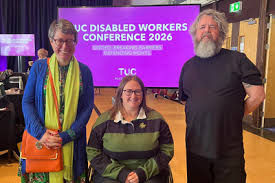
I used to be one of them. But the reason I stand in front of you here today as a broadcaster and presenter and member of the NUJ, rather than a musical theatre performer as a member of Equity, is because the day I became a wheelchair user the sports journalism industry said “hello, you’re welcome” while theatre left me “on my own”
So why when theatre has affected so much change front of house are disabled performers, creatives and backstage workers still left singing “another national anthem” when it comes to their access needs - why can’t “dream a dream” of working in the arts industry.
Well because let’s be honest it’s a battle - one of having to constantly fight for equal access to opportunities, individually having to research into access before accepting a contract, and in order to actually take that contract having to navigate an Access to Work system that has so many delays we could have lost the contract before they even get to our case, and when we do eventually get to talk to a caseworker makes us feel like Oliver Twist asking Mr Bumble for “MORRRRRE!” everytime we need to approach them for help.
Yes in recent years mainstream productions like “The Little Big Things” and the most recent revival of “Into the Woods” have shown what disabled creatives can bring to a production on stage and off when an environment is created with their needs in mind, but they can’t just be a “one song glory”. Not in 2026
As a wise witch once belted we should be “through with accepting limits cause someone else says they’re so”
And that is why conference this motion is so important. Because “except from death and paying taxes, everything in life is only for now”. So let’s work for better and more equal outcomes for disabled creatives, because when disabled people can be “astonishing” and create, produce and perform theatre and art, we can change attitudes and create lasting change long after the final curtain falls.
Because if we support that in the arts industry, who knows how much it can impact practice in other industries like my own - where as one of the first wheelchair users working in women’s football reporting my decision-making on whether a match should be covered is still influenced more by how accessible the stadium is than the actual stories within the game.
Honestly trust me “once we’re centre stage, you watch what happens” "The Time is Now. The Day is Here"
These speeches give us an insight into the experiences of two people and some of their colleagues. Tell us about your experiences in the comment box below this article.

Composite Motion 1: Access to Work – Always Audiences, Never Artists
Conference condemns the deterioration of Access to Work (AtW) through excessive delays, arbitrary caps, and restrictions on support workers, particularly BSL interpreters.
These changes disproportionately impact self-employed, freelance, and gig-economy workers across multiple sectors. Unless Disabled workers are backed by a supportive employer, cuts to AtW result in a myriad of negative outcomes.
Conference recognises extensive evidence from Deaf and Disabled people showing the socio-economic harm caused by these changes, including loss of income, blocked progression, and reduced workforce participation, particularly for lower-paid workers.
Conference notes that while front of house accessibility in arts venues has improved. on stage and backstage accessibility remain an issue for disabled workers in the arts.
This creates additional labour for disabled workers who need to individually contact venues to check if they are accessible to them. When they do get a response from the company or venue, they are often presented with solutions that prioritise the convenience of the company or venue, and don’t meet the disabled workers’ needs.
This gap in venue access not only impacts access to performing or working at events, but also presents significant barriers in recruitment if at the point of applying for a job a disabled applicant has to find out if the interview location, often on-site at a venue, is going to be accessible.
Conference calls on the Disabled Workers Committee to:
i. Treat AtW as a collective trade union priority, coordinating cross-union campaigning, evidence sharing from Disabled members,
ii. Lobbying government to:
iii. Commission and act on substantial, high-quality, data-led research led by Deaf and Disabled people themselves, engaging in meaningful consultation with their representative organisations before making any further changes.
iv. make it a requirement for venues to provide access information for all spaces, not just audiences and front of house perspectives
v. Oppose all cuts or caps to AtW
vi. Demand full reinstatement and expansion of all funding, with focus on support workers
vii. Campaign for disabled jobseekers to be entitled for ‘in principle’ Access to Work indicative awards.
viii. Reject AI as a replacement for human access support
ix. demand timely processing of AtW claims and advocating funding models that truly support insecure and self-employed workers.
x. Convene a meeting between hospitality and arts unions to discuss accessibility for workers in arts and entertainment venues


Comments