
Active Travel Infrastructure and floating bus stops
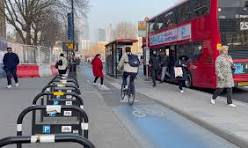
The title of this article may not be attention grabbing but Motion 20 at the TUC Disabled Workers Conference covered a number of important issues including schemes, such as, floating bus stops and pedestrian routes requiring people to cross live cycle lanes to reach crossings, bus stops, or footways.

My colleague from UCU, Cecily Blyther, wanted to make the following contribution to the debate:
Good afternoon, Chair, Conference; I’m Cecily Blyther of the University and College Union – they or she. I’m wearing my favourite colour, old gold; my hair is still brown and I’m wearing it long, today.
Motion 20, for “Active Travel Infrastructure, National Design-Guidance and Disabled People’s Safety”, is the one I hope we vote for to take to Congress, especially because of its pro-active nature and positive character, as I will illustrate later. In this world of rapidly- … usually too rapidly-developed ideas, then designs and implementations, it is extremely important to consider all the implications on every single person’s safety.
Consider air-conditioning, which is in the news, today. Everything has to be constantly kept up-to-date. At present, we can flatly refuse to work in very cold conditions, because there is a hard and fast rule. There is now talk about setting a limit for very hot conditions.
If only life were that simple, … but we will end up with rules that won’t all be possible to obey. Instead, we need design guidelines that, when followed, take into account every consequence, not just an arbitrary selection.
Of course, it is not only the design of conditions of travel but of working and living conditions that are becoming increasingly diverse. So, in order to keep well-adapted to all changes, it is imperative that representatives of Blind, visually-impaired, Deaf and all Disabled people are always included in the design.
Furthermore, surely it follows that when we are fully-included in decisions about living, working, travel and everything else … then … we will be more likely to be accepted as natural participants in every part of life, … and … the social model will then become more naturally-accepted and part of everyone’s life. Our ultimate aim is for every person to be accepted for themselves … and for their necessary support needs (– necessary adjustments) to be provided.
Tell us what you think about floating bus stops and pedestrian routes requiring people to cross live cycle lanes to reach crossings, bus stops, or footways. Tell us about your experiences in the comment box below this article.

Motion 20 - “Active Travel Infrastructure, National Design-Guidance and Disabled People’s Safety
Conference notes that local authorities are expanding active travel infrastructure in line with national design guidance issued by UK and devolved governments.
These schemes include features like floating bus stops and pedestrian routes requiring people to cross live cycle lanes to reach crossings, bus stops, or footways.
Blind and visually impaired people, wheelchair users, and others with mobility or cognitive impairments are required to rely on the behaviour of cycle traffic, with no signal control or enforceable priority. Many disabled people cannot safely detect, judge or negotiate fast-moving cycles, e-bikes and e-scooters, particularly at unclear layouts or inconsistent design. Safety concerns have been raised in Glasgow and Manchester, and other cities.
Conference believes that the risk arises from national design standards rather than local implementation failures.
Conference calls on the DWC to:
i) Call for an immediate pause on the roll out of floating bus stops and uncontrolled cycle lane crossings where disabled people must cross cycle traffic.
ii) Demand an urgent UK-wide review of national active travel design guidance, including guidance issued by the DfT and devolved administrations.
iii) Ensure blind and visually impaired people and other disabled people are directly involved in rewriting this guidance.
iv) Campaign for Equality Impact Assessments to assess real world safety, confidence, and independence, rather than procedural compliance.
v) Campaign for accessible, inclusive street design for disabled pedestrians.”


Comments